
Atascocita Previous Residents by Era
The strongest route to prior households is a relay between the present parcel, recorded land instruments, and household sources. Atascocita is an unincorporated Harris County community, so the relevant records are kept by county and library custodians rather than an Atascocita city clerk. An appraisal record can identify the current parcel and owner of record. A deed can document a transfer. A directory, census, newspaper, or obituary can provide a separate clue about a household. Each source answers a different question.
| Source | Years It Covers | Where Held | What It Shows |
|---|---|---|---|
| Harris County recorded land books | County collection from 1836; images from November 1, 1960 | Harris County Clerk | Recorded instruments and historical ownership leads; older images use counter or microfilm routes |
| HCAD appraisal and parcel records | Current online records | Harris County Appraisal District | Account, owner of record, situs and mailing addresses, legal description, and map links |
| Houston city directories | 1866-1986 runs; 1866-1923 digitized | HPL, HCPL, Texas State Library, and HeritageQuest | Address and household clues, with Houston-centered coverage |
| Federal census | Released under the 72-year rule; 1950 is public | NARA and library databases | Household composition and residence context at enumeration |
| OCE permit material | BCode single-family and duplex issue coverage from September 1, 2009 | Harris County OCE and ePermits | Construction or inspection timing; no broad public address-person index was located |
For a recent Atascocita address, start with the HCAD account and the Clerk's land index. For a much earlier household, begin with the best known address, surname, or event, then test Houston directory and census coverage before concluding that the area had no resident history.
Atascocita Previous Residents Start at a Parcel
The Harris County Appraisal District property search is the modern starting point for an Atascocita address. It can return an account number, owner of record, property address, mailing address, legal description, values, exemptions, taxing jurisdictions, ownership-history link, map, and sketch. Record the account number and legal description before changing tools. An account is a stable bridge when the street has a Humble postal label or a subdivision name that differs from everyday Atascocita usage.
| Account number | The parcel or account identifier used to keep the current appraisal record anchored. |
|---|---|
| Situs address | The physical parcel address, which may use Humble as the postal city. |
| Mailing address | An address for tax correspondence; it is not proof that the recipient lives at the parcel. |
| Legal description | Subdivision, lot, block, unit, tract, or abstract wording that connects the parcel to deeds and plats. |
| Ownership-history link | A useful appraisal lead that still needs a recorded-instrument check. |
HCAD is an appraisal record, not title proof. An exemption claim or owner listing should not be converted into a statement about who occupied the address. The map may also lag account changes. Use the current parcel card to form a precise Clerk search, then read the recorded instrument.
Tracing Atascocita Previous Residents Through Deeds
The Harris County Clerk Real Property index is the transfer side of the Atascocita trail. It supports grantor, grantee, trustee, subdivision or description, instrument type, date range, volume and page, file number, film code, and several legal-description fields. Search party names last name first without punctuation. A name-only result can be noisy, so carry forward the lot, block, subdivision, document number, or recording date from each instrument.
- Search the Atascocita address in HCAD and copy the account number, current owner of record, and full legal description.
- Search the current owner as grantee in the Clerk index, narrowing with the subdivision or legal-description wording and a reasonable date range.
- Open the purchase deed and record the seller, execution date, recording date, legal description, instrument or file number, and linked documents.
- Search that seller as grantee before the transfer date, using the same lot, block, tract, or subdivision terms.
- Repeat the relay backward, checking whether a plat changed the subdivision wording or whether the deed conveyed more than one lot.
- When a prior party is an entity, follow the entity name and the next deed instead of assuming an individual household connection.
- Grantor and grantee
- The grantor is the party conveying an interest. The grantee is the party receiving it. Those roles reverse the search direction as the chain moves backward.
- Chain of title
- The sequence of recorded transfers and related instruments connecting an earlier interest to a later one.
- Legal description
- The lot, block, subdivision, tract, or abstract wording that identifies land more reliably than a street address in older records.
Keep a dated chain worksheet. Construction date, appraisal year, deed execution date, recording date, and tax-year ownership can differ. When the legal description changes, search both the former and later subdivision or lot wording, and check the related plat or prior instrument number before joining the records.
Atascocita Deed Images and Older Books
The Clerk's Real Property search states that images are available from November 1, 1960, while the county's land-record collection reaches back to 1836. New documents can take one to two business days to appear. The online database is not the official repository, and it may be incomplete or contain statutory redactions. For a prior Atascocita transfer before the online image period, use the older microfilm or deed-book route through the Clerk rather than inventing a gap in the property history.
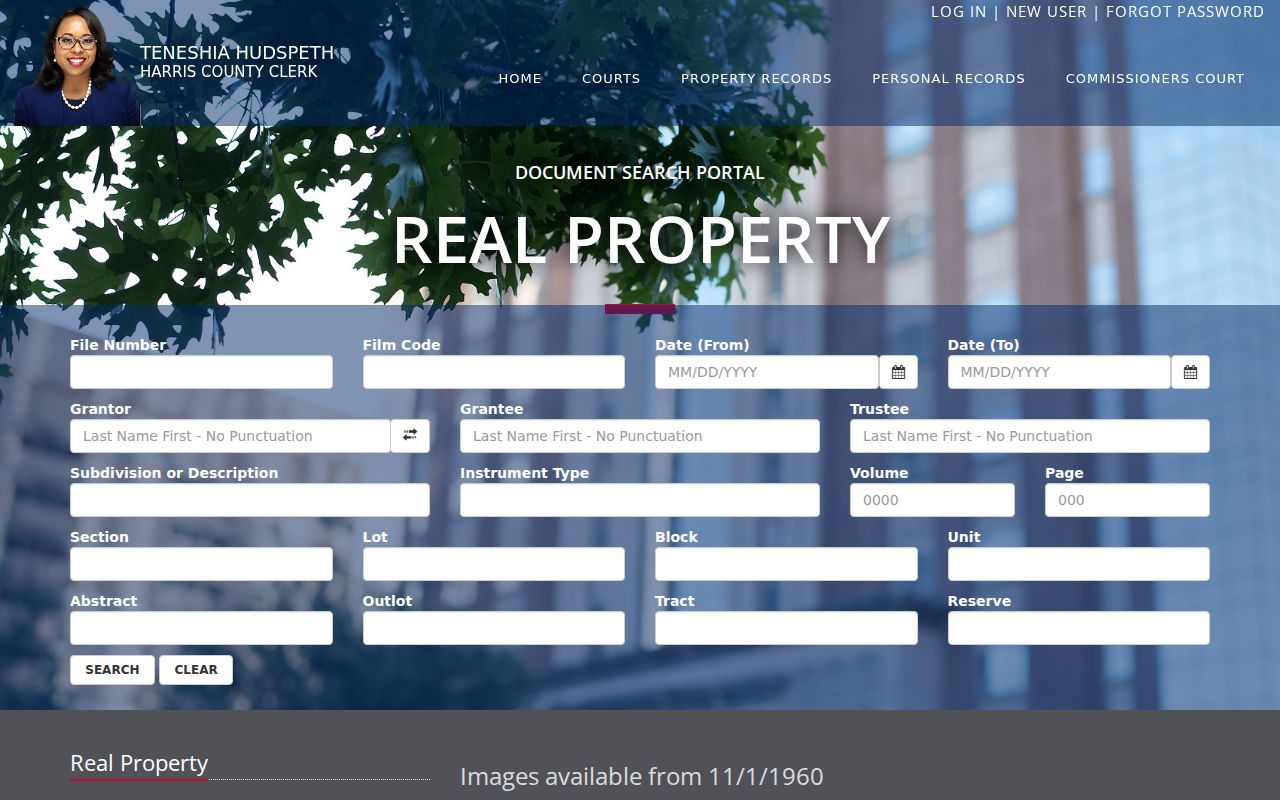
The index form supports the party, date, file-number, volume-page, and legal-description search repairs needed to carry an Atascocita deed chain across the online and offline divide.
Harris County reports that nearly 110,000 microfilm rolls were removed through its digitization work, but older-method research remains necessary for pre-1960 land images. The Clerk's public-records channels include annexes, mail, email, and phone support. An image or certified copy is the correct follow-up when the index alone cannot resolve a date, signature, legal description, or related release.
Atascocita Previous Residents in Directories
Recorded owners and household occupants are not the same thing. For the household layer, the Houston digitized city-directory collection offers the copyright-free 1866 through 1923 run, with an alphabetical citizen section and street guide or householder directory. Later Houston material is available through library shelves and partial database access. These are Houston-centered sources, so an absent Atascocita entry can be a coverage issue rather than evidence that no household was there.
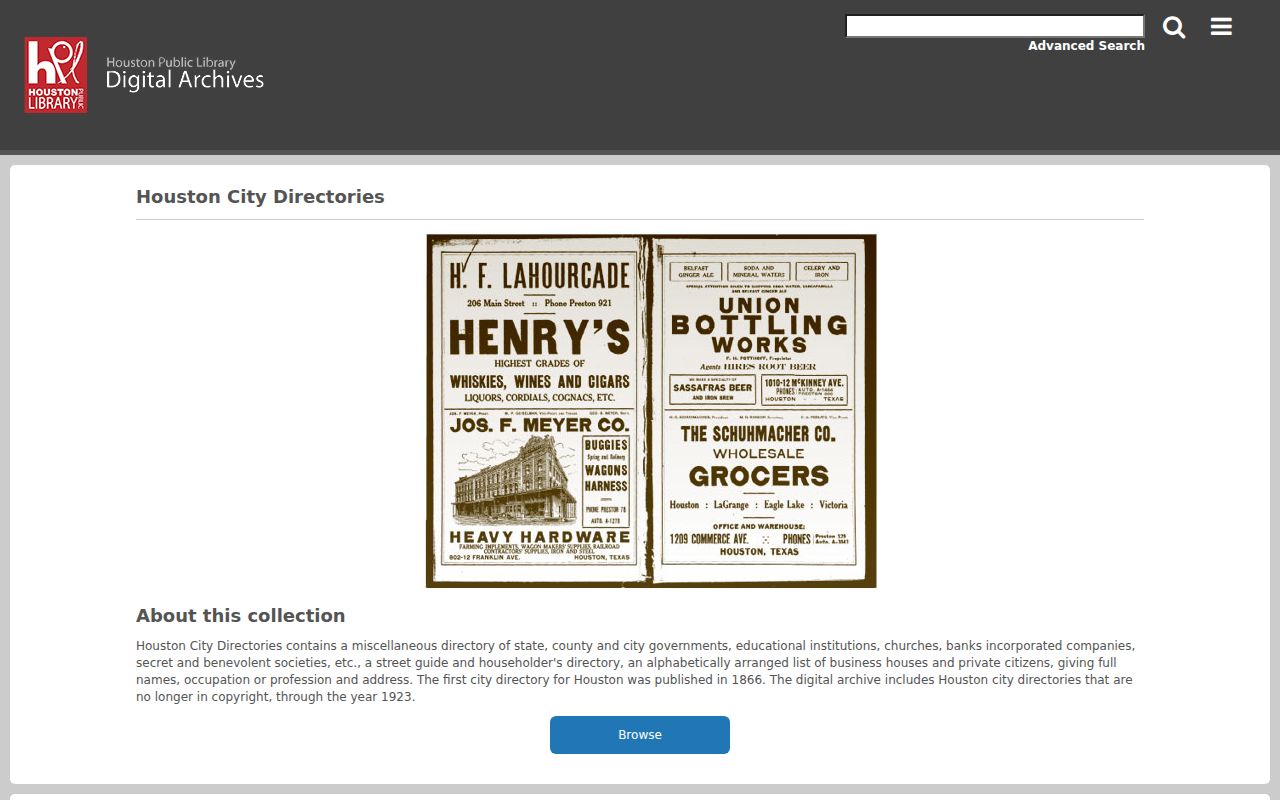
The collection image shows the browse and search route for a historical directory lead. Open the page scan and read the volume's own abbreviation key before attaching meaning to a shortened term or address mark.
The historical shelf and entry-reading method are detailed in the Atascocita city directory. On an address trail, use the street-guide or householder section to test the property, then return to the deed chain, census, or newspaper record for proof. Houston Public Library reference staff cannot search directories by phone number, and its address-request service has limits, so a precise year, surname, and address are valuable.
Atascocita Directories and Census Pairing
Pair directory years with released federal census schedules instead of treating either source as complete. The 1950 census is public under the 72-year release rule. Earlier directories can place a name near an address between census dates, while the census adds household composition, age, relationship, and residence context at a fixed enumeration date. A move can happen between those dates, so record the source date beside every address.
Address trail: parcel and legal description → recorded deed and prior grantor → directory street or householder search → census household → obituary, probate, cemetery, or newspaper check. Atascocita searches need street-name variants, number variants, and sometimes a nearby-town or land-description search because older material may not use the modern CDP name.
Houston Public Library genealogy resources include Houston Chronicle coverage from 1901 through 2017 and current coverage, Houston Post coverage from 1880 through 1995, and selected funeral-home records. Search name variants and event dates. A newspaper hit can point to a family relationship or move, but it does not replace an address-specific record.
Atascocita House-History Maps and Guides
The Houston neighborhood-history guide supplies a useful worksheet for an Atascocita address: abstract and deed-chain research, probate, directories, census, newspapers, maps, and archives. Substitute HCAD and the Harris County Clerk for the local parcel and instrument work. Plats are especially useful where a street address changed form or a later filing reconfigured a subdivision.
Digital Sanborn Maps are listed through HCPL with a stated 1867 through 1970 collection range. When a sheet covers a site, compare street names, footprint, materials, outbuildings, and lot context across editions. Do not assume that an early urban map includes an Atascocita subdivision. A permit, plat, or public infrastructure map can date construction or subdivision activation, but it does not identify every household.
Note: No verified Atascocita street-renumbering timeline was located, so test street-name variants and legal descriptions before treating a search miss as a lost address.
Atascocita Past Residents at Trail's End
Obituaries and probate can close a historical trail. A death notice may identify family, a previous residence, a funeral home, or a cemetery. A probate file may identify heirs and addresses. Neither result proves that a named person lived at the researched Atascocita address. Match the date and address to the deed transfer, directory, census, or other independent record before making that connection.
Houston Public Library identifies Fogle-West funeral-home records from about 1921 through 1975 and Boulevard records from about 1961 through 1967, along with its newspaper resources. The Harris County Clerk also holds probate and county-civil records. These routes can provide a relationship lead when the previous-residents trail ends in a death or estate record, but the parcel's legal description remains the safer anchor for a property conclusion.
Lawful use. Atascocita house-history and family-history research should remain personal and lawful. Do not use a past address, name, or record to harass, stalk, or track any living person.